
Red Blood Cell Removal from Whole Blood
Without Centrifugation
Posters & Presentations
Cell-manufacturing workflows, including those used to develop and manufacture CAR-T and other cell-based products, may require isolation of lymphocytes from cellular starting materials. In a study presented by ElevateBio at ASGCT 2025, CELLNETTA was evaluated as a process material for ex vivo PBMC isolation from whole blood. The study assessed red blood cell and platelet depletion and lymphocyte recovery under the experimental conditions described below.
*This work was presented by Elevatebio at the American Society of Gene and Cell Therapy (ASGCT) Annual Meeting held in New Orleans, USA, on May 15, 2025, as part of a case study on the application of CELLNETTA.
*Portions of the original presentation poster are used here with permission from Elevatebio.
*The full poster can be accessed here.
Methods
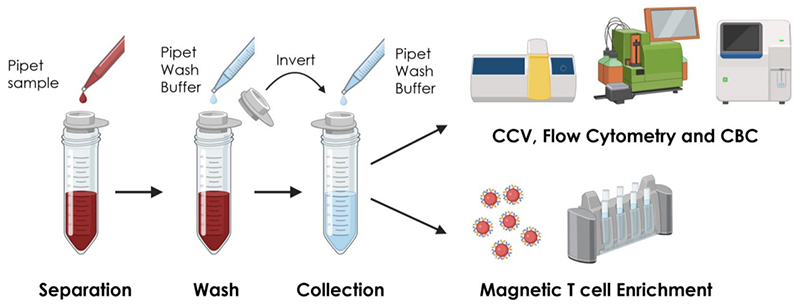
- (1)Whole blood was diluted 10–20 fold with DPBS/EDTA buffer containing 1% human serum albumin (HSA).
- (2)A hydrophilized CELLNETTA* membrane was placed on the top of a centrifuge tube, and the diluted whole blood was applied onto the membrane.
- (3)After filtration, the CELLNETTA membrane was inverted and placed onto a new centrifuge tube. Washing buffer was passed through the membrane to recover the cells retained within the mesh.
- (4)A portion of the recovered cells was analyzed by flow cytometry and complete blood count (CBC) to determine cell numbers and calculate recovery rates.
- (5)The remaining recovered cells were subjected to T‑cell isolation using antibody‑coated magnetic beads.
*Hydrophilization procedure, see CELLNETTA Hydrophilization Manual.
*For detailed instructions, please refer to the CELLNETTA User Guide, Hydrophilization Manual.
*The above is provided as a reference example to illustrate possible use cases and is not a validated manufacturing instruction. Users must establish, qualify, and validate their own processes and determine the suitability of CELLNETTA for their intended manufacturing application.
*For detailed technical advice, please contact us.
Results
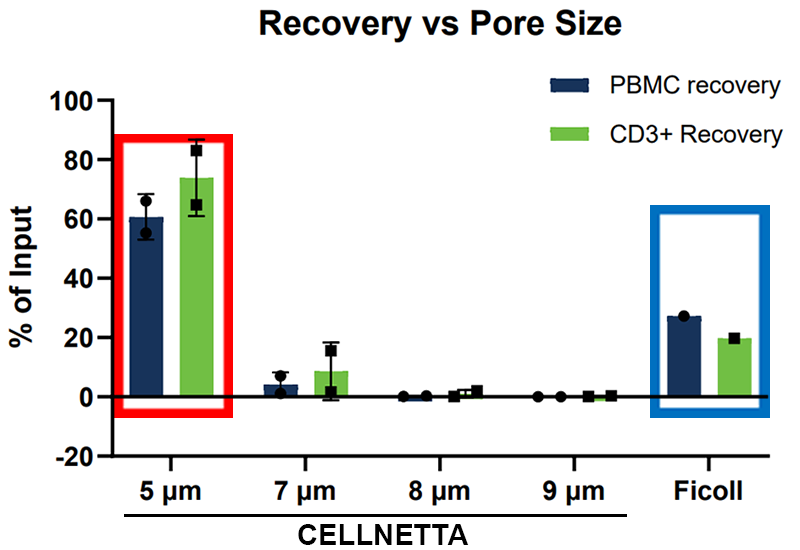
We compared the conventional density gradient centrifugation method using Ficoll with CELLNETTA membranes of various pore sizes (5, 7, 8, and 9 μm). First, recovery rates of total PBMCs and CD3‑positive (CD3⁺) cells were evaluated (Figure 1). Both PBMC and CD3⁺ lymphocyte recovery rates were higher when using CELLNETTA with a 5‑µm mesh (red box) compared to the conventional method (blue box).
Next, the removal rates of red blood cells and platelets from the resulting PBMC fractions were assessed (Figure 2). Platelet removal was more effective with CELLNETTA 5 µm mesh compared with the Ficoll‑based method.
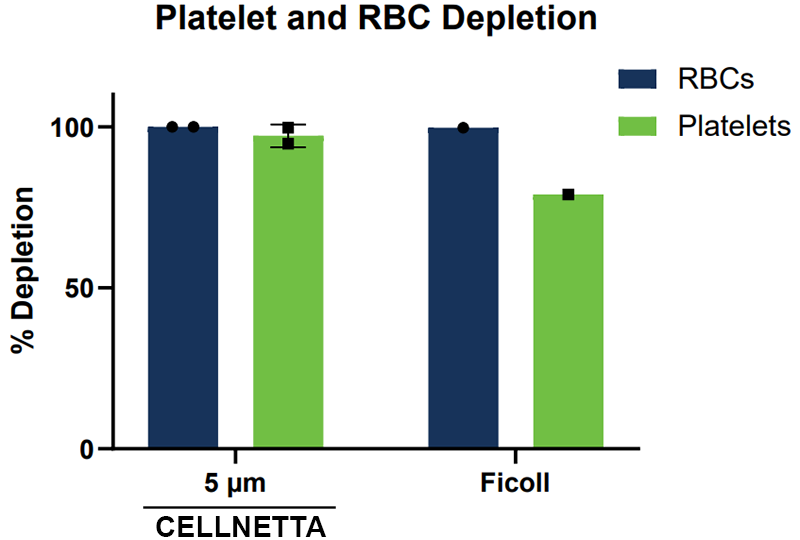
RBC and platelet depletion in retained PBMCs compared to automated ficoll gradient separation. Data represented as mean ± SD of two donors.
We also compared the efficiency of magnetic bead–based T cell isolation from whole blood with and without the use of CELLNETTA. As shown in Figure 3, the proportion of T cells within the PBMC fraction was higher when CELLNETTA was used prior to magnetic bead separation. Figure 4 demonstrates that the use of CELLNETTA did not significantly affect T cell purity or viability.
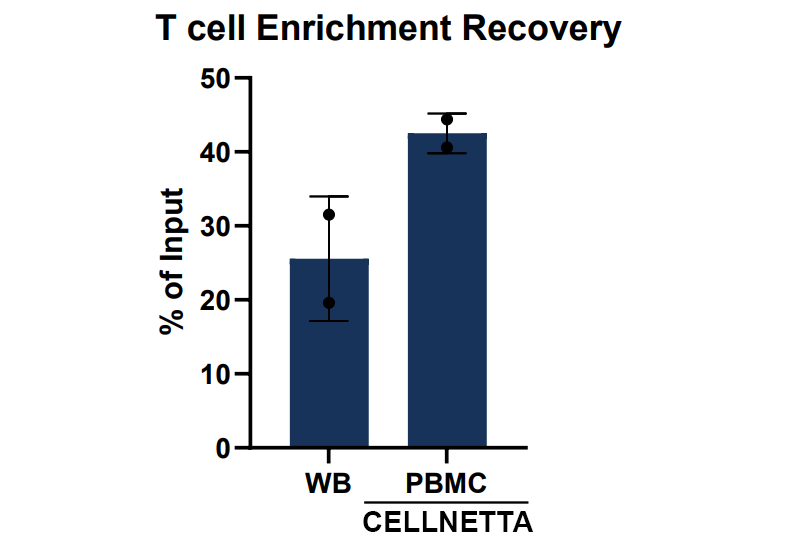
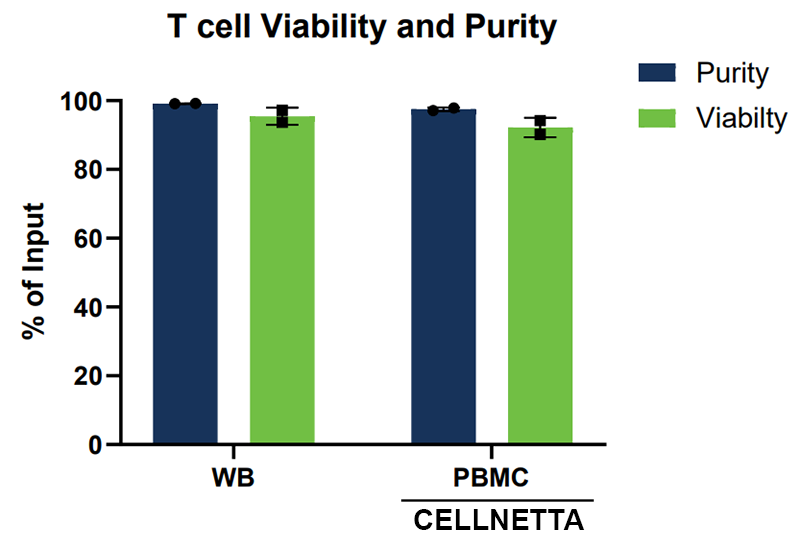
Effect of CELLNETTA pretreatment on T‑cell isolation from whole blood using antibody‑coated magnetic beads.
WB: T‑cell isolation performed directly from whole blood without CELLNETTA. PBMC: T‑cell isolation performed from PBMCs obtained after CELLNETTA filtration.
From these findings, Elevete Bio concluded that CELLNETTA with a 5‑μm mesh provides more efficient red blood cell removal directly from whole blood compared with the Ficoll method, resulting in PBMC fractions of higher purity.
CELLNETTA Used
| Pore size | Package Quantity | Product Number |
|---|---|---|
| 5 µm | 1 | MZM1B005B50GA |
| 5 | MZM1B005B50GB | |
| 7 µm (custom made) | - | Please contact us. |
| 8 µm (custom made) | - | Please contact us. |
| 9 µm (custom made) | - | Please contact us. |
Notes
- ●This product is not a medical device.
About 7 µm (custom made), 8 µm (custom made), and 9 µm (custom made)
- ●This product is a sample for evaluation purpose.
- ●Please do not ship out your completed product with the sample.
- ●We shall not be liable for any claims on the sample in case it is shipped out to the market.
CELLNETTA Details
For purchasing inquiries, click here. For product inquiries, click here.
This product is single-use only.
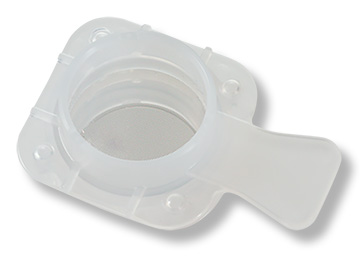
- Compatible with 50 mL centrifuge tubes
- Individually packaged
- Made in Japan
- Gamma irradiated
| Size compatible with 50 mL centrifuge tubes | |||
|---|---|---|---|
| Pore Size (μm) | Package Quantity | Part Number | Application Examples |
| 5 | 1 | MZM1B005B50GA | Purification of culture medium from cell suspensions Removal of red blood cells from whole blood/PBMC |
| 5 | MZM1B005B50GB | ||
| 10 | 1 | MZM1B010B50GA | Purification of single cells |
| 5 | MZM1B010B50GB | ||
| 15 | 1 | MZM1B015B50GA | Fractionation of clusters and single cells |
| 5 | MZM1B015B50GB | ||
| 20 | 1 | MZM1B020B50GA | Fractionation of clusters and single cells |
| 5 | MZM1B020B50GB | ||
| 100 | 1 | MZM1B100B75GA | Spheroid size-based sorting for drug efficacy testing |
| 5 | MZM1B100B75GB | ||
| 200 | 1 | MZM1B200B75GA | Fractionation of microcarrier beads Spheroid size control |
| 5 | MZM1B200B75GB | ||
*We recommend selecting a pore size slightly smaller than the target cells. Please contact us
for guidance on selecting the optimal pore size for your application.
*Flow behavior may vary depending on cell morphology, flow conditions, and other
factors.